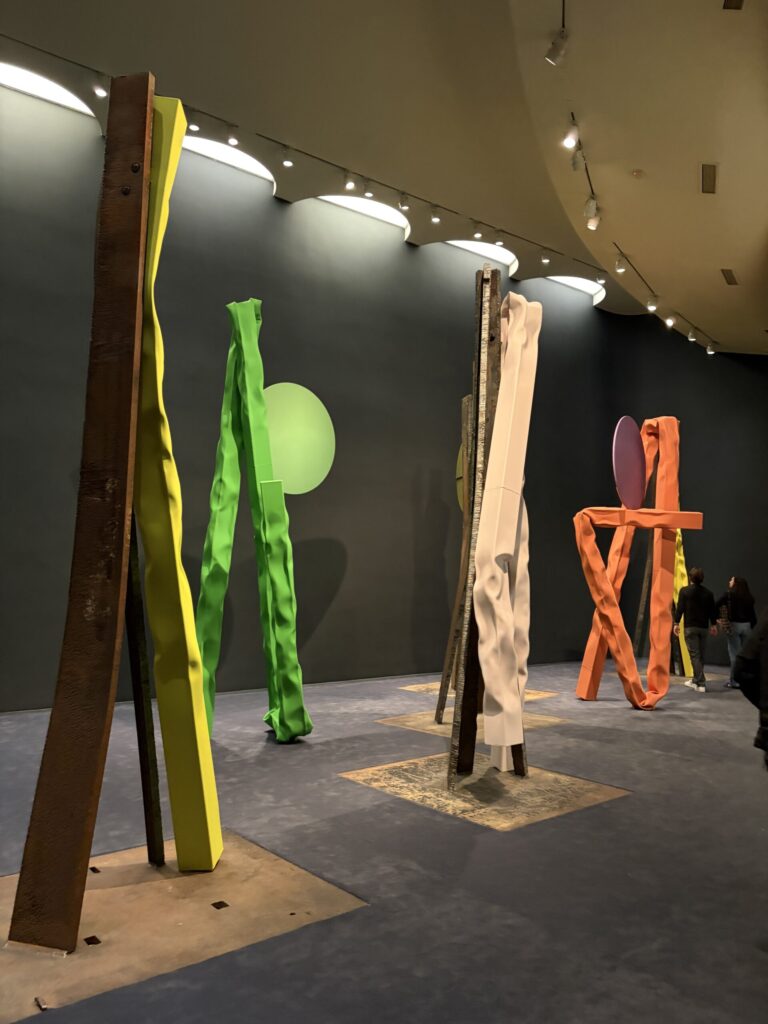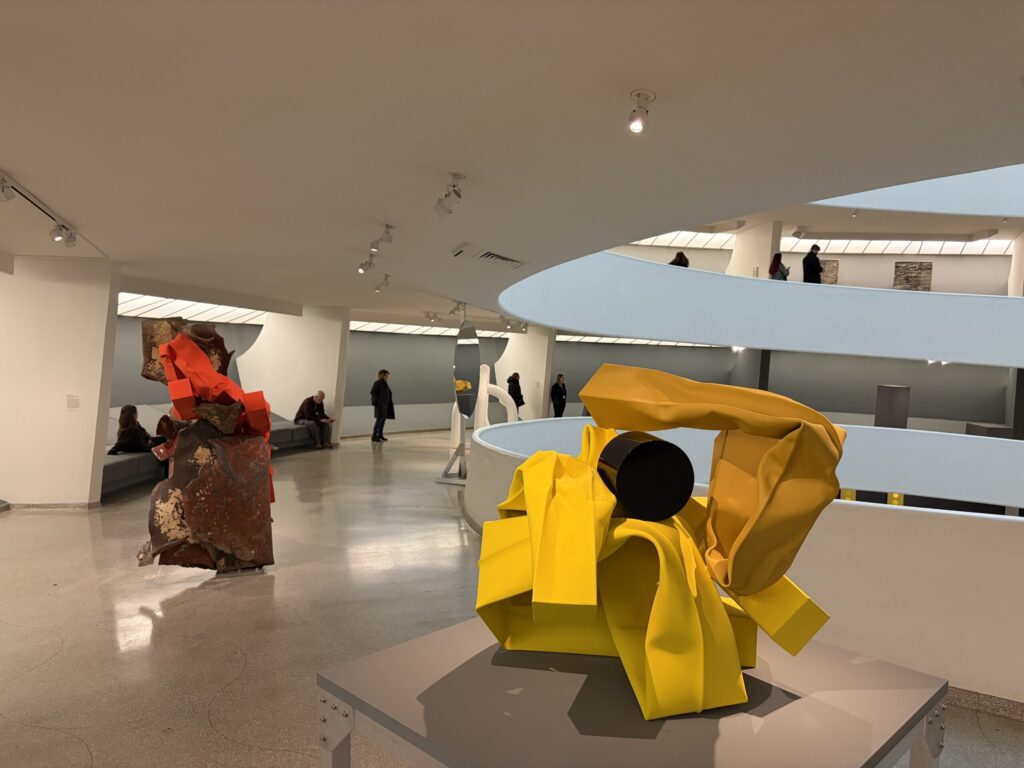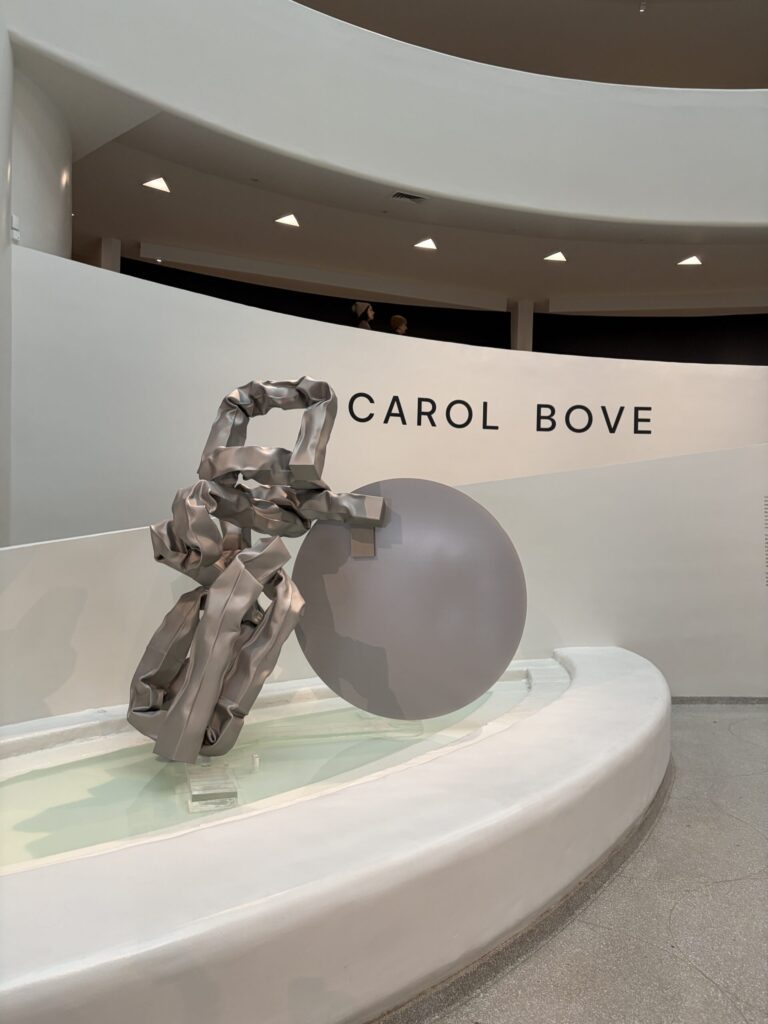
As an art advisor and appraiser, I often see how institutional recognition and the secondary market move together in shaping an artist’s trajectory. A compelling example right now is the survey of Carol Bove at the Guggenheim Museum in New York.
Installed along the museum’s iconic spiral ramp, the exhibition unfolds in reverse chronological order—starting with Bove’s recent monumental steel sculptures and moving back to earlier works. Filling the Guggenheim’s rotunda, the show traces key developments in her practice over more than 25 years. Bove’s work ranges from assemblages of paperback books and intimate paper collages to monumental steel sculptures.
She is best known for bending industrial steel into expressive, flowing forms that appear almost effortlessly shaped by hand. In reality, the works are produced using powerful hydraulic presses in her Brooklyn studio, creating a striking illusion where rigid steel seems unexpectedly soft—almost like fabric caught in motion.
This growing institutional visibility has been mirrored by strong performance in the secondary market. Bove’s auction record stands at $787,500 (including buyer’s premium), achieved in November 2022 at Sotheby’s in New York for Dressing Room (2017). The result followed her widely acclaimed 2021 facade commission at the The Metropolitan Museum of Art, The séances aren’t helping.
Her stainless-steel sculptures typically achieve between $250,000 and $600,000 at auction. A recent example is Melty Legs (2018), which realized $714,366 at Christie’s in London in March 2026. Since 2023, Bove has been represented internationally by Gagosian after a 12-year collaboration with David Zwirner.
The exhibition is on view until August 2, 2026—and well worth seeing.